



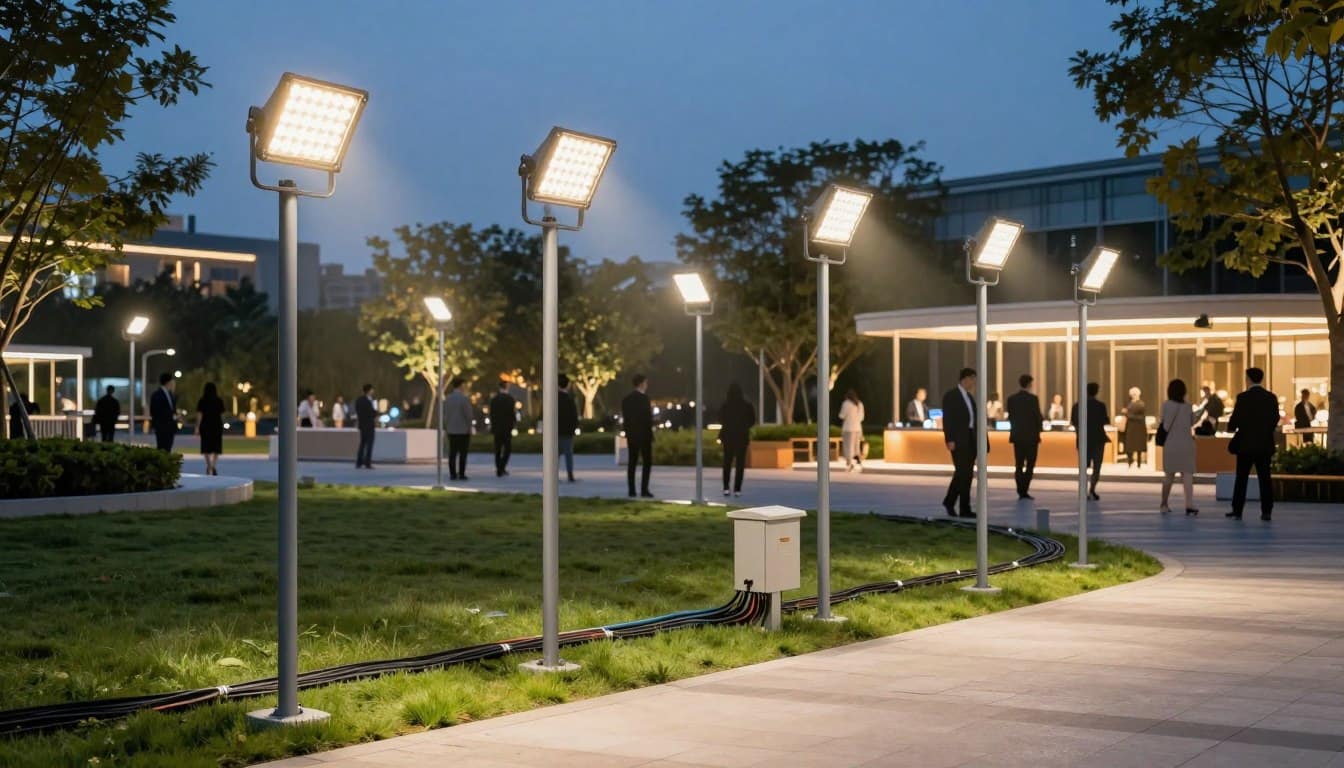
Commercial outdoor LED lighting works best when fixture choice, wiring, mounting height, controls, and service access are planned as one system. This approach improves visibility, limits wasted light, and supports safer, more efficient outdoor lighting.
Quick answer: Choose an area light for parking and drive lanes, a wall pack for entries and service doors, and flood or roadway fixtures for façades and access routes. Use weather-resistant, code-compliant wiring, then test zoning, sensors, photocells, and reset settings before commissioning.
This guide is for property owners, facility managers, electricians, and landscape contractors. Connecticut sites may require additional planning for snow, ice, freeze-thaw movement, coastal moisture, drainage, anchors, conduit, buried cable, soil, grass, and planting beds.
Review ISON IAHP1 and Gen 2 IAHP2 area light options, along with HARRIS LSWF2, FLGA4, and RDWL1 products. Compare lumen output, optics, beam spread, mounting height, and glare control rather than wattage alone. An optic directs light; beam spread describes its coverage; a photometric plan predicts illumination; a photocell turns fixtures on when daylight fades; and zoning groups lights for efficient control.
Use this installation planning guide to compare optics, wiring, controls, and mounting needs. For lower-voltage landscape connections, review low-voltage landscape options. Balance security, plant protection, efficiency, maintenance, and service access before you request quote from ctlawn.net for a professional quote.
Key Takeaways
- Confirm product specifications and local code before installation.
- Match mounting height, beam spread, lumen output, and light distribution to the site.
- Use durable, weather-resistant wiring and accessible connections.
- Test controls, sensors, photocells, and reset settings on site.
- Protect visibility, plants, drainage, and maintenance access.
What Fixtures Suit Commercial Outdoor LED Lighting?
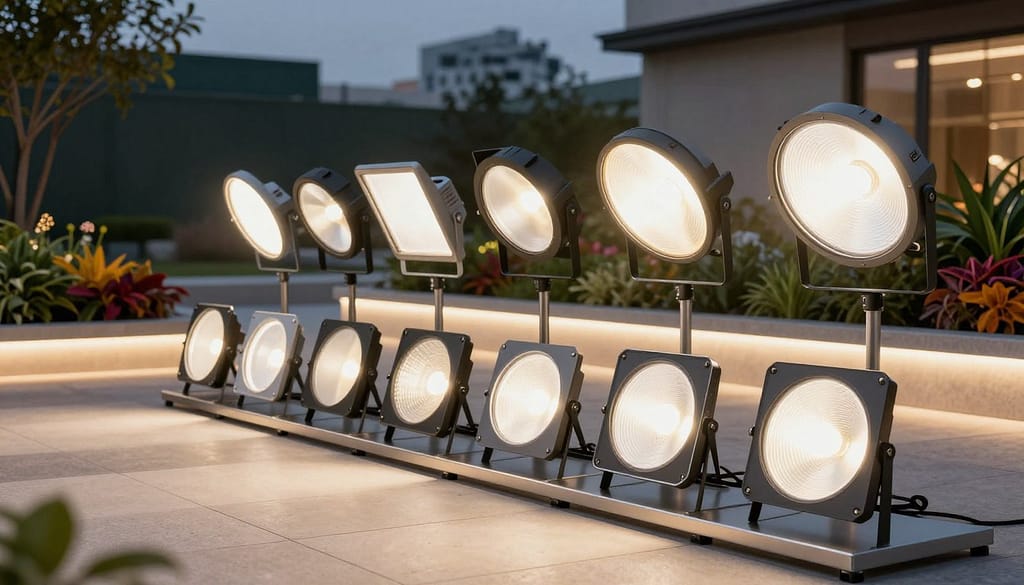
Choose fixtures by application: an area light covers open parking and drives, a wall pack serves vertical surfaces and doors, an architectural flood light highlights façades and signs, and a roadway lighter supports internal lanes. Compare lumen output, optics, mounting height, uniformity, glare control, controls, service access, and local electrical rules—not wattage alone. Use this commercial fixture planning guide to develop an initial layout.
ISON Area Lights for High-Performance Site Coverage
ISON IAHP1 and Gen 2 IAHP2 area light options may suit parking lots, loading zones, drive lanes, and site edges. An area light high performance design should be selected through a photometric plan that compares lumen output, mounting height, spacing, uniformity, and glare. A high performance LED area light can improve coverage, but final performance depends on the site and selected optics.
HARRIS Wall Packs and Canopy Lights
The HARRIS Lumen Select Canopy Square LSCS1 may suit covered entries, fueling areas, and pedestrian transitions. A lumen select wall pack lets the designer match output to the application. Select an LSWF2 wall pack full cutoff model when limiting uplight and light trespass is important. Choose LSWS2 when a wall pack semi-cutoff pattern provides useful wall brightness. Review the manufacturer’s HARRIS lumen data before choosing a HARRIS LED wall pack.
Architectural Flood Lights and Roadway Lighters
FLGA4 is an LED architectural flood option for façades, signs, corners, and landscape features. Aim each architectural flood and flood light carefully to reduce glare for drivers, pedestrians, and neighboring properties. The RDWL1 is an LED roadway lighter for internal drives and access lanes; confirm whether the HARRIS LED roadway product meets the required distribution and uniformity. Use these fixture adjustment tips after installation.
- Full cutoff: directs light downward and can reduce upward spill.
- Semi-cutoff: permits limited light above the horizontal plane for broader wall distribution.
- Controls: test sensors, photocells, timers, and reset settings during commissioning.
| CategoryModelBest fitCT note | |||
| Area | IAHP1 / IAHP2 | Parking and drives | Check snow exposure |
| Wall or canopy | LSCS1 / LSWF2 / LSWS2 | Entries and walls | Limit neighbor glare |
| Flood or roadway | FLGA4 / RDWL1 | Façades and lanes | Confirm access and code |
Request a quote after reviewing the photometric plan, wiring route, maintenance needs, and product specifications. This comparison helps determine whether the selected area light, lumen select wall pack, architectural flood, or roadway fixture fits the property.
How Should Commercial Outdoor LED Lighting Be Wired?
Use this seven-step checklist before trenching: assess the load, map circuits, select conduit, protect connections, install controls, test the system, and document the results. Mark panel capacity, disconnects, fixture loads, control zones, service points, and the wiring route. A professional wiring planning guide can support this review.
Planning Safe, Durable Wiring for New England Conditions
Connecticut freeze-thaw cycles, moisture, and stone can affect buried conduit. A qualified electrician must confirm current electrical code, trench depth, bedding, seals, grounding, bonding, GFCI, surge protection, wet-location equipment, and mechanical protection for the installation type. Keep junction boxes accessible, use rated connections, and separate line-voltage outdoor lighting from low-voltage landscape circuits.
Plan each run for the lumen select wall pack, wall pack full cutoff, wall pack semi-cutoff, FLGA4 flood light, and RDWL1 roadway lighter. Check voltage drop, limit splices, and verify the HARRIS LED roadway requirements, ISON LED area light load, and control compatibility. Photocells, timers, sensors, dimming, and network controls can divide zones and reduce waste. This low-voltage wiring resource may help with landscape circuits. Before energizing, the electrician should test voltage, photocell timing, sensor range, astronomical timer settings, emergency shutoff, reset functions, and nighttime uniformity.

| Planning itemPrimary concernRecommended check | ||
| Buried conduit | Movement and moisture | Confirm applicable depth, bedding, seals, and protection |
| Connections | Corrosion and faults | Use rated boxes, bonding, grounding, and GFCI |
| Controls | Unneeded operation | Test zones, sensors, timers, dimming, and reset settings |
Which Layout Works Best for Business Properties?
Plan outdoor lighting in this order: map pedestrian and vehicle movement, identify hazards, place primary fixtures, check overlap, review glare and light trespass, then validate the design with photometrics. Mark accessible entrances, paths, stairs, parking aisles, loading areas, dumpsters, and building approaches before selecting each light.
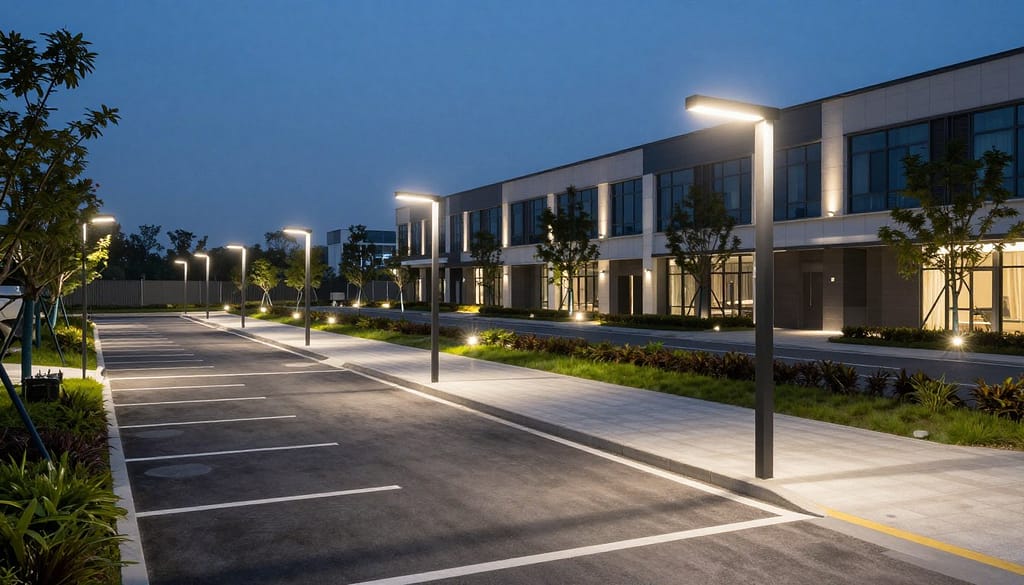
Pole height, mounting arm, setback, beam distribution, and tree growth affect coverage. IAHP2 area light high performance fixtures may overlap parking and circulation zones, but a photometric review should confirm whether overlap is necessary. Keep poles and junction boxes clear of plow routes, drainage paths, accessible routes, mowing, and repairs.
- Use LSCS1 beneath covered entries and canopies.
- Choose an LSWF2 select wall pack full cutoff fixture near service doors to limit uplight.
- Use LSWS2 when a lumen select wall pack semi-cutoff pattern provides useful wall brightness.
- Aim FLGA4, an led architectural flood light, at signs and façades without driver or pedestrian glare.
- Use RDWL1, an led roadway lighter, along internal drives and turning areas.
For example, an area light can cover parking spaces, a wall pack can illuminate a service entrance, and a roadway fixture can support an internal drive. Account for Connecticut soil, salt, turf, tree growth, and snow storage. Confirm illumination, uniformity, glare, sightlines, pavement markings, and control zones with a photometric plan. Pair the design with professional landscape installation services, then request quote before approving pole locations or installation timing.
Conclusion
Effective outdoor lighting combines the right fixture, safe wiring, controlled distribution, and a traffic-based layout. ISON products offer high performance for parking areas, while HARRIS LED products serve canopies, façades, walls, and roads. Match each select wall pack, lumen select wall unit, or area light to its specific task.
Review snow storage, soil movement, drainage, turf, tree growth, coastal moisture, power capacity, glare, controls, and service access. See commercial fixture options and this low-voltage setup guide. For a quote, prepare the property address, site plan, operating hours, pole locations, fixture needs, and maintenance goals. Then request quote from CTLawn before trench routes are approved.
FAQ
What works best for a Connecticut parking lot? An area light should match pole height, lumen output, traffic, snow storage, power capacity, and the photometric plan.
Which wall pack pattern fits? Choose full cutoff to limit uplight and glare, or semi-cutoff when broader wall distribution is appropriate.
How do I get a quote? Contact CTLawn for a property review, lighting plan, installation estimate, and maintenance quote.
Meta Title: Commercial Outdoor LED Lighting Installation Guide